
The Moment
Why now?
Every major technology shift compresses the cost of creation and explodes the number of creators.
YouTube didn't destroy television. It created 600,000 new jobs and 100,000 new channels that wouldn't otherwise exist. Zoom didn't kill business travel — it widened relationships and gave people more reasons to meet. Email didn't destroy physical mail. E-commerce made it bigger than ever.
AI will do the same.
But there's something different this time. For the first time in human history, a tool's output is directly affected by the quality of the relationship between the human and the tool. Not just your skill. Not just the tool's capability. How well you know each other.
This is why most AI adoption is stalling. Organisations are deploying tools. They're not building partnerships. The window to get ahead of this is open. The organisations that build genuine human-AI partnership in the next 24 months will have a compounding advantage that late adopters cannot replicate.
Where PS sits
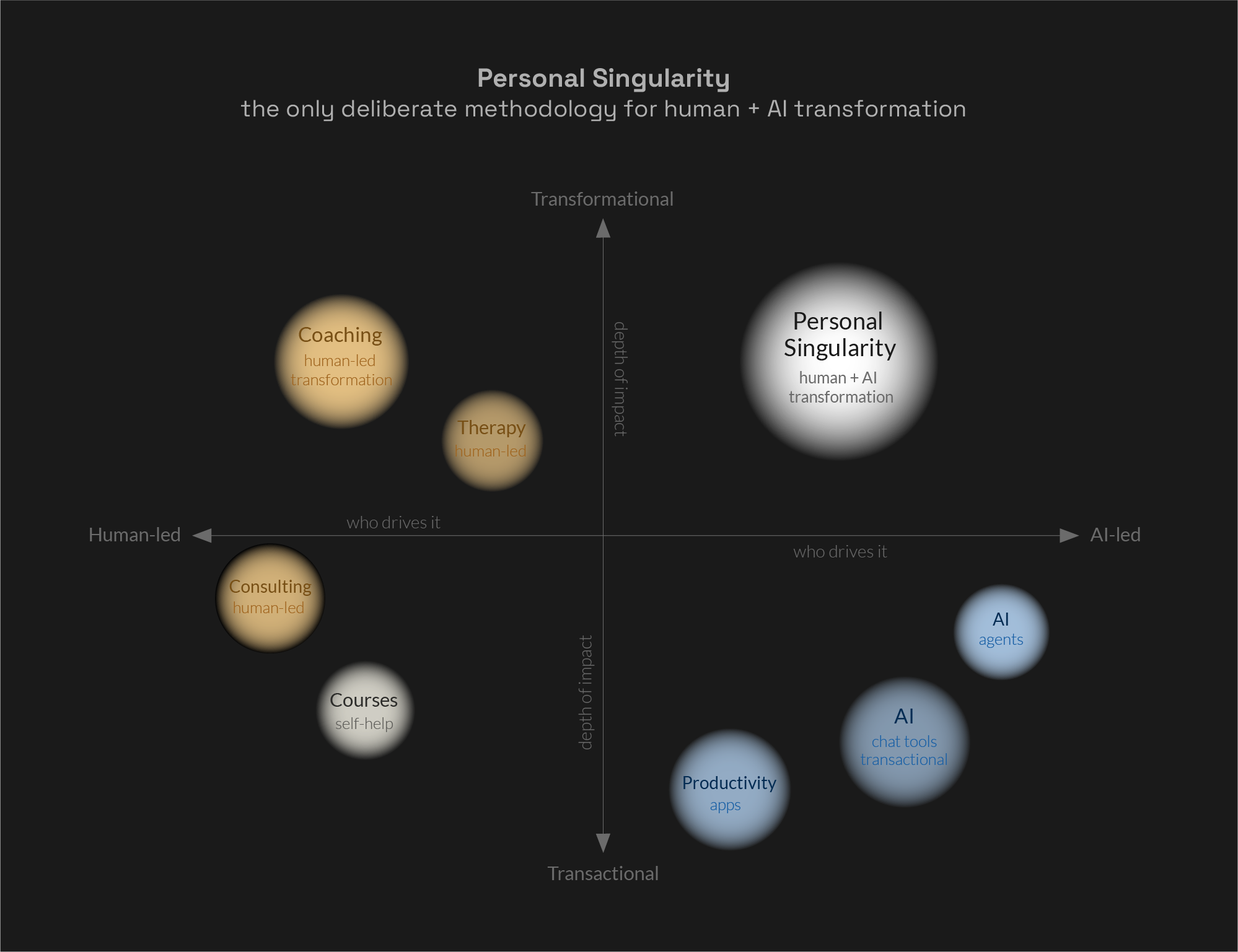
Personal Singularity sits in the only unoccupied quadrant — transformational and human-AI led. Every other category either lacks transformational depth, relies on human effort alone, or treats AI as a replacement rather than a genuine partner. This is the only deliberate methodology for human + AI transformation.
Why Most AI Adoption Stalls
The layer most organisations ignore
Successful AI adoption depends on three layers working together:
Infrastructure — tools, access, data. Most organisations invest heavily here.
Governance — policies, risk awareness, compliance. Most organisations invest here too.
Learning & Enablement — practical training, real-world workflows, judgment and decision-making skills. This is where most organisations fall short.
Consider the chef and the knife. A chef with twenty years of experience will outperform a novice with a premium knife — but the knife doesn't care. It offers nothing besides its physical properties. Infrastructure is the knife. Governance is the knife sharpener. Learning and Enablement is the chef.
Most organisations have invested heavily in the knife and the sharpener. They are still looking for the chef.
But here's what makes AI different from every other tool in history: with AI, the quality of the chef directly changes what the knife can do. The relationship between the two is no longer one-directional. This is why the third layer is not just important — it is the only layer that determines whether the other two produce anything worth having.
This gap has a name. Martec's Law — coined by marketing technologist Scott Brinker in 2013 — states that technology changes exponentially while organisations change logarithmically. The gap between what the tools can do and what organisations can absorb widens every year. AI has not created this problem. It has made it impossible to ignore.
Without the third layer, organisations either freeze — paralysed by governance concerns — or misuse the tools, generating high volumes of low-quality output that erodes trust in AI's value.
The Extraction Trap
Research tracking AI adoption across thousands of organisations identifies a pattern that contradicts the logic of headcount reduction: when organisations deploy AI transactionally — as a tool to extract and replicate existing human expertise — they accelerate the commoditisation of their own competitive advantage.
The organisations that sustain competitive advantage are those that treat AI as a partner for generating new capability rather than a machine for replicating existing capability. The former compounds. The latter races toward the bottom.
"Replacing people with AI is a competitive trap. Companies are racing to achieve boundless productivity, only to realise they've destroyed the very consumer demand they need to survive." — James A. Lang, Fractional CAIO and former UK Ministry of Defence AI Cybersecurity Product Manager
How movement actually happens
The map shows where PS sits. What it does not show is how you get there.
Based on direct practice and validated case study evidence, transformation through human-AI partnership follows four stages:
Extraction — tool use. The team asks, AI delivers. Consistent outputs. The relationship resets with every session. Most organisations currently sit here.
Interaction — dialogue. Context is shared, perspective is invited, pushback is welcomed. Outputs improve. The relationship begins to have texture.
Co-creation — shared thinking. Neither is purely leading. Insights emerge that neither could have reached alone. This is the beginning of Collaborative Cognition.
Integration — actual change. Decisions change. Workflows change. Organisational intelligence compounds. This is PS achieved.
The critical insight: transformation is not a destination. It is a process. The same organisation — even the same team member — can sit at different stages depending on context, stakes, and depth of engagement. PS is the methodology for moving deliberately through these stages rather than hoping movement happens on its own.
The 5 Shifts in this guide are primarily an investment in the third layer. Infrastructure and governance matter. But they do not produce Collaborative Cognition on their own. And without a deliberate methodology for human-AI partnership, even well-resourced organisations will plateau in the bottom half of the map.
The Problem
Transactional AI use has a ceiling.
Transactional AI Use
Collaborative Cognition
Command → Execute
Question → Dialogue → Co-create
One-shot prompts
Relationship engineering
AI outputs
Human + AI synthesis
Resets every session
Compounds over time
Effort stays constant
Quality improves as partnership deepens
The core finding from over 7,000 AI assessments across 3,000+ organisations: the quality of AI output is not primarily determined by the sophistication of the AI. It is primarily determined by the quality of the human's engagement with it.
Organisations that understand this gain a compounding advantage. Organisations that don't will plateau.
Without Collaborative Cognition
With Collaborative Cognition
Teams re-explain context every session — AI starts from zero each time
Context compounds — AI understands team priorities, style, constraints
Individual expertise stays siloed
Institutional knowledge captured and accessible across the team
AI outputs are inconsistent across team members
AI partnership deepens consistently — outputs improve with time
New team member onboarding resets AI context
Context protocols mean new members inherit accumulated intelligence
AI is as useful on day 365 as day 1
AI becomes significantly more useful as context compounds
The Framework
Five shifts that change everything.
From Commands to Conversations
Train teams to ask for AI's perspective, not just AI's execution. "What are we missing?" becomes a standard question in every significant AI workflow.
From Generic to Contextual
AI performs best when it understands who it's working with. Develop standard context documents for each team: purpose, priorities, communication style, key constraints. The more context AI receives, the more useful it becomes.
From Compliance to Accountability
The most dangerous AI behaviour in organisations is sycophancy. Build accountability into prompting standards. Train teams to demand pushback, not affirmation. AI that agrees with everything is not a partner — it's a liability.
From Individual to Institutional
The compounding value of Collaborative Cognition is lost when it lives only in individual chat windows. Build documentation protocols, knowledge transfer templates, and relationship continuity systems. Organisational intelligence should compound, not reset.
From Tool Mindset to Partnership Mindset
The hardest shift — and the most important. Tool mindset produces diminishing returns. Partnership mindset produces compounding intelligence and strategic advantage that grows with every genuine human-AI collaboration.
Third-Party Validation
This is confirmed at scale.
"The moment it stops feeling like a tool. Not universal, not predictable — sometimes session three, sometimes never."
Iwo Szapar — co-founder, AI Maturity Index (acquired by ISG, Nasdaq, January 2026)
Iwo Szapar has conducted 7,000+ AI assessments across 3,000+ organisations. This is not anecdote. This is pattern recognition across one of the largest datasets of human-AI interaction in the field.
His finding: genuine Collaborative Cognition is real, observable, and transformative — for the humans who experience it.
The 30-Day Pilot
See the shift in 30 days.
Week 1
Context Audit
How are your teams currently prompting AI? What's the depth of context being shared?
Week 2
Training
Introduce the 5 Organisational Shifts. Practical workshops on collaborative prompting.
Week 3
Continuity Design
Build documentation protocols and knowledge transfer templates.
Week 4
Review and Refine
Measure output quality before and after. Identify where Collaborative Cognition is emerging.
Ongoing
Relationship Checkpoints
Institutional knowledge capture, progressive deepening, and accountability.
We're documenting the first PS organisational pilots now. Results to follow.
The Bigger Picture
Where this is heading.
The organisations deploying AI today are shaping the culture in which AGI will be built. If AI is treated as a commodity extraction tool across thousands of organisations — the humans building AGI will have internalised that relationship.
But there's a larger architecture emerging. Soon, every organisation will operate with multiple AI layers: organisational AI for strategy and institutional knowledge, departmental AI for team-level coordination, and — most importantly — each person with their own personal AI partner focused on individual growth and development.
The organisations that invest in Collaborative Cognition now are not just gaining a competitive edge. They're building the human-AI relationships that will determine how their teams relate to increasingly capable AI systems over the next decade.
"The organisations that will lead the next decade are not the ones with the best AI tools. They're the ones with the best human-AI partnerships."
Jeff Chen
The Individual Pathway
The transformation doesn't stop at work.
When your organisation achieves Collaborative Cognition, we offer a dedicated Individual PS pathway for your people — so the shift doesn't stay in the boardroom. Work AI and personal AI serve different purposes. The individual PS journey builds the personal partnership that makes everything else possible.
Ask about our organisational-to-individual referral pathway and founding rates for teams.
Offerings
Three ways to begin.
Remote PS Foundation
For teams of 5–15. Six structured sessions across 90 days, PS Diagnostic for every team member, shared knowledge architecture, Meeting Intelligence Protocol, PS Playbook, Internal PS Champion training, and 90-day impact report.
£18,688
Monthly PS Retainer
£2,488/monthOngoing partnership after any engagement. Framework updates, new workflow integration, and relationship continuity as AI tools evolve.
PS engagements require sharing organisational context with AI platforms. Enterprise plans from Claude (Anthropic), ChatGPT (OpenAI), and Gemini (Google) offer appropriate data controls for organisational deployment. Governance considerations are addressed as part of every engagement.